













GeForce GTX 580 vs Quadro 5000
High Poly Count Environment
To cover the impact of graphics processing power in more conventional 3D production situations, TurboSquid was kind enough to donate a New York City scene model for our tests (Product ID # 605641).
 Using this scene file, we created a 900-frame camera move to test viewport playback speed as well as simulate viewport interactivity. We received multiple versions of the file for different renderers and realized that the V-ray version of the file had a poly count of 5,427,133 and a vertex count of 3,804,888 spread over 19,151 objects, while in the Mental Ray version it appeared that the modeler had attached multiple pieces of geometry, resulting in 4,101,683 polygons and 4,360,321 vertices spread across only 107 objects. Historically, 3ds Max has had an easier time handling high poly counts over fewer objects than high poly counts spread over many objects. With this in mind, we decided to test the graphics cards under both circumstances. For these tests we also tested using both the Nitrous viewport drivers and DirectX. When possible, we tested in realistic, wireframe, and shaded (no textures) viewport modes.
Results
Set 1 (Polycount: 5,427,133 Vertex: 3,804,888 Object 19,151)
For Test 7 (Nitrous, realistic viewport mode), the GeForce resulted in a playback time of 23 minutes, 9.8 seconds, while the Quadro blazed  through in 8 minutes, 1.4 seconds. The DirectX results came in slightly faster than Nitrous, with the GeForce clocking in at 22 minutes, 22.8 seconds, and the Quadro speeding along at 6 minutes, 28 seconds. Bear in mind that there is a subjective component to this test, which is viewport image quality. Even though the Nitrous results of this test came in slightly slower than DirectX, the image quality was superior.
For Test 8 (Nitrous, wireframe viewport mode), the GeForce resulted in a playback time of 4 minutes, 19.1 seconds, while the Quadro came in slightly slower at 4 minutes, 23.2 seconds. The DirectX version of this test, however, resulted in a much slower GeForce speed of 7 minutes, 8.9 seconds, while the Quadro’s results were similar to its Nitrous speeds at 4 minutes, 29.6 seconds.
 For Test 9 (Nitrous, shaded with no textures viewport mode), there was no easy one-click equivalent for DirectX to turn off all textures, so we only ran this using Nitrous. The GeForce produced a playback time of 8 minutes, 31.1 seconds, and the Quadro nearly doubled that speed with a time of 4 minutes, 30.9 seconds.
Set 2 (Polycount: 4,101,683 Vertex: 4,360,321 Object 107)
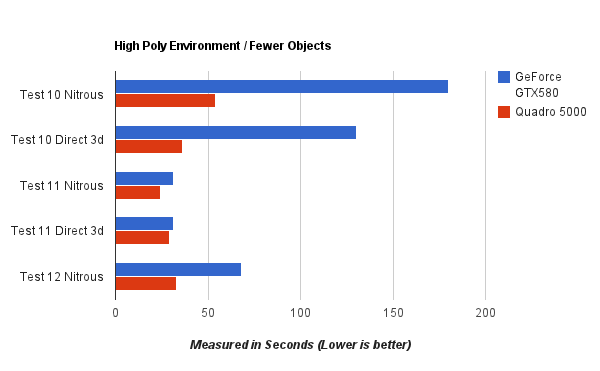
For Test 10 (Nitrous, realistic viewport mode), the GeForce resulted in a playback time of 2 minutes, 59.9 seconds, while the Quadro blazed through in 54.2 seconds. The DirectX results came in slightly faster than Nitrous, with the GeForce clocking in at 2 minutes, 10.1 seconds, and the Quadro speeding along at 36.2 seconds. Again, under Nitrous, the image quality was superior.
For Test 11 (Nitrous, wireframe viewport mode), the GeForce resulted in a playback time of 31.5 seconds, while the Quadro came in at 24.1 seconds. The DirectX version of this test, the GeForce came in at the same speed of 31.5 seconds, while the Quadro’s results were slightly faster, at 29.2 seconds.
For Test 12 (Nitrous, shaded with no textures viewport mode), we again only ran this using Nitrous. The GeForce produced a playback time of 1 minute, 8.1 seconds, and the Quadro was 33.2 seconds.
Conclusions (so far)
As we had suspected, the 512 CUDA cores found in our GeForce GTX 580 had a clear advantage over the 352 CUDA cores of our Quadro 5000 when using the CUDA enabled glu3d GPU Edition. The fact that the GTX 580 nearly doubled the performance of the Quadro 5000 on these tests is good news for those of you who do a lot of fluid simulations. However we were surprised by the slightly faster performance by the Quadro in our MassFX tests which would seem to support industry chatter that MassFX does not completely take advantage of CUDA and in fact must currently rely heavily on the CPU.
Based on the results from our high-poly-count NYC scene tests, it would appear that the Quadro 5000 has a clear advantage in functionality that is almost universal for all 3ds Max users, namely viewport interactivity and viewport playback speeds. While test results of wireframe viewport performance were essentially even between the cards, the shaded and realistic mode results for the Quadro 5000 were 2 to 4 times faster than those of the GTX 580. Add to that the fact that with faster performance came equally better image quality in regards to texture map display, shadows, AO in the viewport, etc, it becomes much easier to justify the higher price point (around $1,750 street price) for the Quadro line.
Instead of trying to tell you what card you should buy, here’s what I would and most likely will do.
If I had only one machine and needed to choose between the two cards, I would get a Quadro 5000 because it would positively affect 90%-95% of my work. For a second machine, I would get a GeForce GTX-580 (street price from $380-$430) and use that machine to run my liquid sims, and eventually rigid body and cloth sims once MassFX matures over time to take advantage of the CUDA cores. Hopefully soon the Nvidia engineers and marketing machine will release newer Quadro cards that can eliminate our need to make a choice between great overall performance and specialized CUDA-enabled performance.



How about new Titan… with 2600 CUDA cores… 6GB of memory… some said that’s 2.2x stronger then GTX 580. That would give us much stronger card still cheaper then even Q6000.
And how about quadro k5000?
I admit, I’m confused… 🙂
Yes thanks for the suggestion, We’re planning to do an update to this review with more up to date hardware. Stay Tuned.
i would love to see Titan versus K5000
3d max viewport performance
“NYC Max User Group | GeForce GTX 580 vs Quadro
5000” ended up being extremely compelling and
useful! Within todays society that’s really difficult
to execute. Thanks a lot, Jackie
[…] http://www.nyc3d.org […]
[…] http://www.nyc3d.org […]
Thank you very much for a great work!
Best comparison ever with clear conclusion.
So now I have to find some money for Quadro….
TITAN K5000 in 3DS MAX VIEWPORT, would be great!!!
What a great review!Thumbs Up!
Would be great to have an updated comparison between newer cards though..
Keep up the good work, this article was very helpful!