













GeForce GTX 580 vs Quadro 5000
Our Test Platform
The machine that was used in this round of tests was a Venturi workstation from RAIN Computers with an Intel Core i7 CPU with 12 gigs of RAM running Windows 7 Professional 64 bit. Our thanks to Kevin Jacoby, Jami McGraw, and everyone at RAIN for their generous donation and support. Special thanks to Chris Turco and PNY Technologies for supplying the initial two graphics cards for our tests. Testing was done on 3ds Max 2012 (release 14, service pack 2). The latest NVIDIA drivers for both the GeForce and the Quadros were downloaded for testing. We used version 296.1 for GeForce and version 296.7 for Quadro. Note: On the NVIDIA drivers download site, there is a 3ds Max performance driver available, which we downloaded but discovered it only supported max 2009, 2010, and 2011. At the date of this writing it would not let you install for 3ds Max 2012. If and when that becomes available we will run the tests using that as well. As soon as the user group receives its copy of 3ds Max 2013, we will re-run these tests to see the performance differences between the versions of Max.
CUDA Core Test
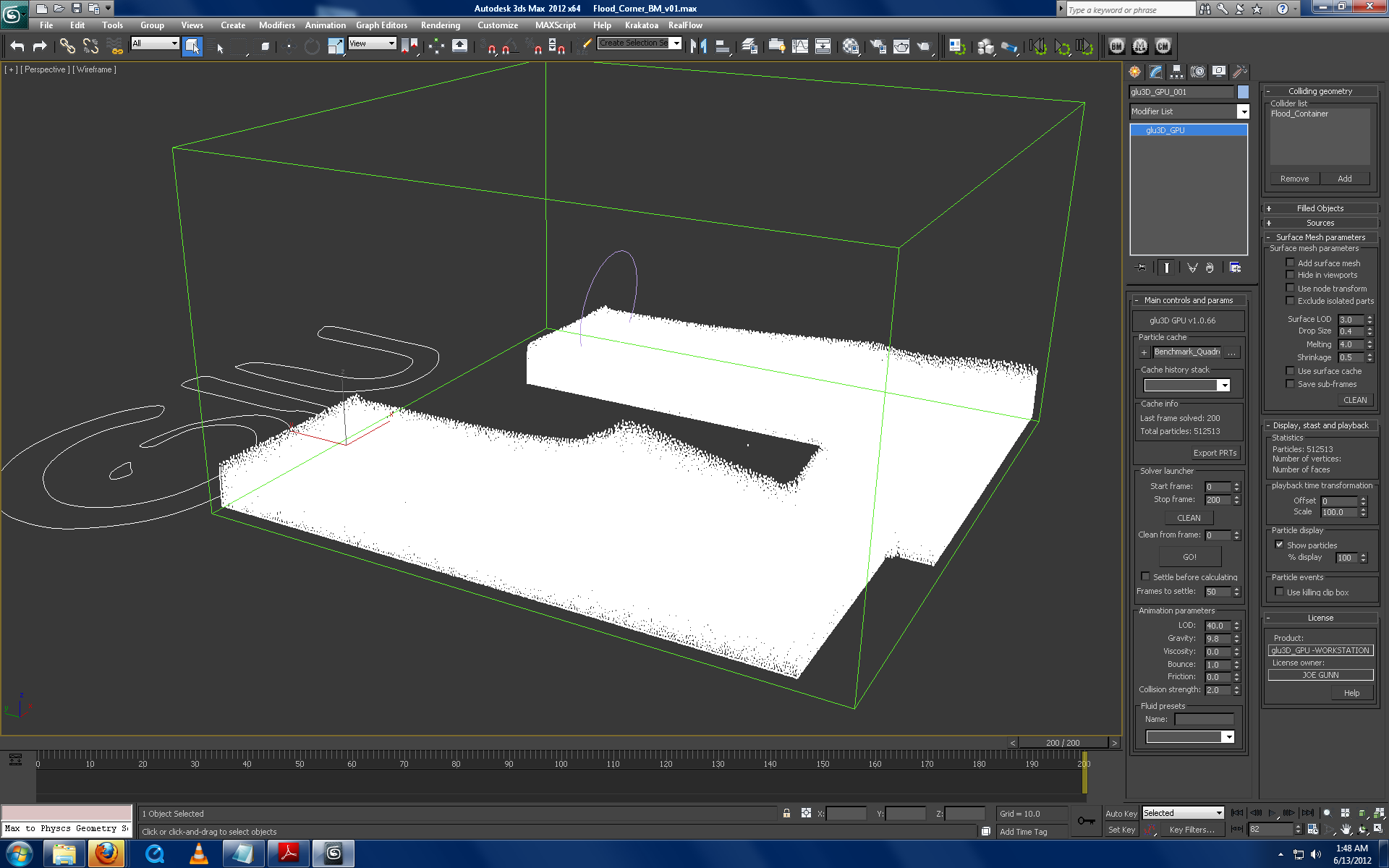 For our CUDA core test, we used a file from Joe Gunn’s glu3D demonstration at the user group in April 2012. The file generates 512,513 particles in a 200 frame fluid simulation using default settings. In test 1 we simply ran the simulation and did not touch the machine, while in test 2, in order to simulate user viewport interaction, we looped viewport playback while the simulation calculated.
The glu3D CUDA test on the GeForce resulted in a simulation time of 32 minutes and 10 seconds, while the Quadro took 1 hour and 3 minutes. Similarly, test 2 resulted in a GeForce time of 33 minutes and 19 seconds, and the Quadro took 1 hour and 3 minutes. Clearly, there is negligible impact on the CUDA calculations when interacting with the viewport during calculations, but the GeForce’s 512 CUDA cores vs. the Quadro’s 352 CUDA cores makes a significant difference on software that is written to harness the parallel processing power of CUDA cores.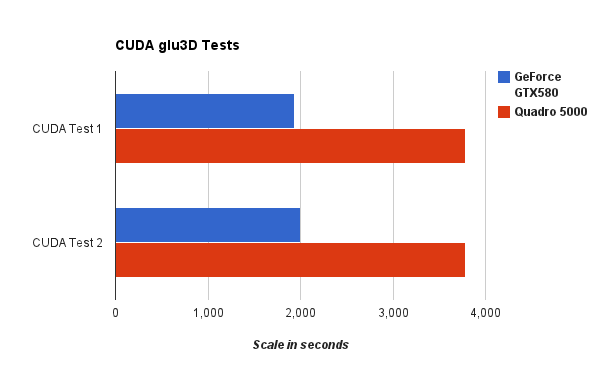
Side note: during testing, we wanted to see if glu3D’s batch mode would result in improved speeds compared to running it conventionally in the Max UI. Batch mode in glu3D allows the user to run a simulation without having to launch Max, hence without having to use the graphics card to display any user interface. Surprisingly, our initial tests of batch mode came back with the same exact simulation times as the tests we ran using the UI, so we did not continue testing.
Mass Effects Tests
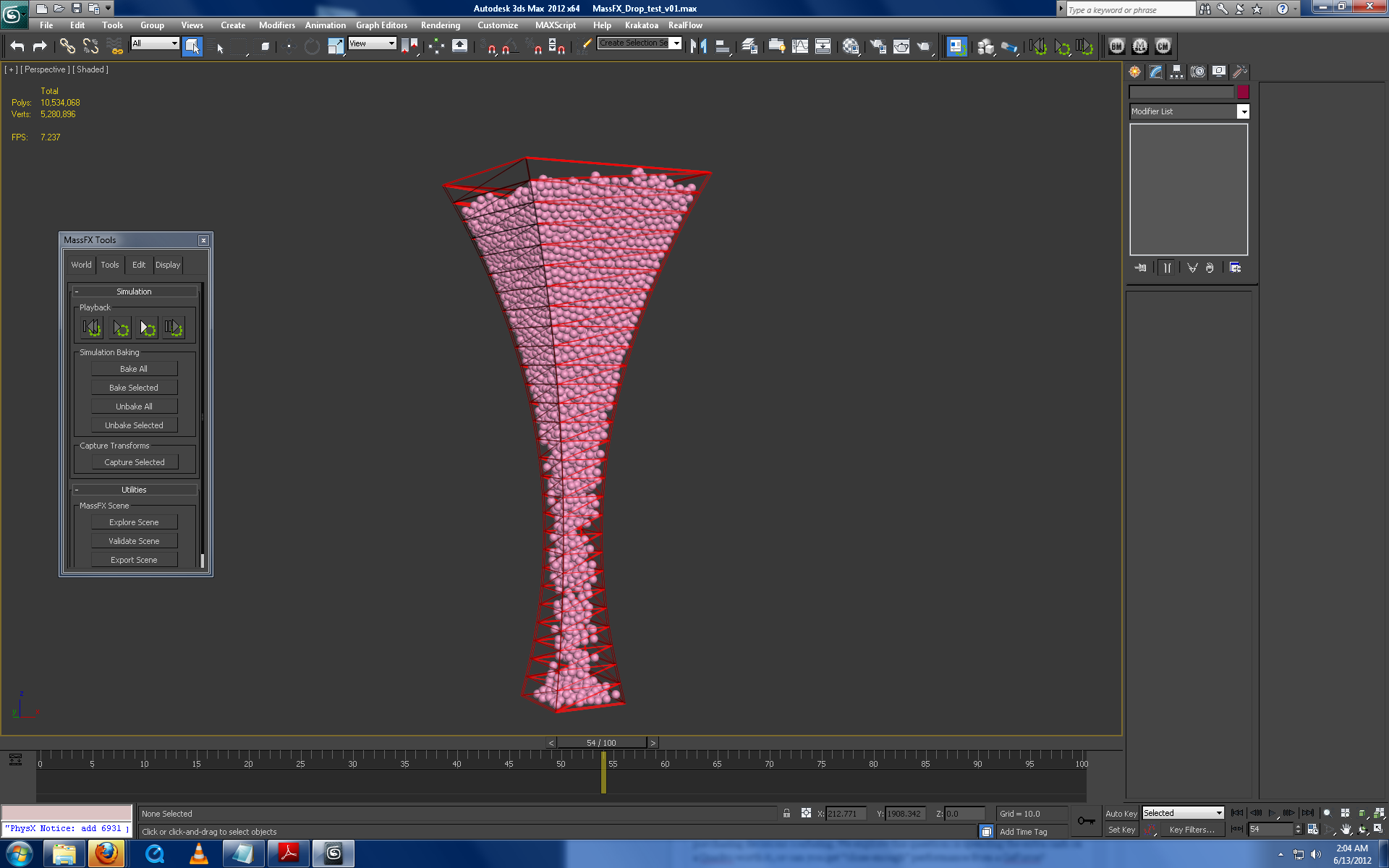 We decided to see what performance differences there would be using these cards when using Max’s new Mass Effects feature. We created two variations of a test file with multiple spheres being dropped into a shaped vase-like container. The only difference between the two files was the number of spheres used. In test 5, we had a total of 6,931 objects with a total scene poly count of 10,534,068 and a vertex count of 5,280,896. In test 6, we had a total of 1,079 objects with a total scene poly count of 1,639,028 and a vertex count of 821,672. In both tests, we set rigid body substeps to 6 and recorded the playback/calculation time from frame 0 to 100. We also tested playback of the baked simulation for both files.
The results of test 5 calculation/playback resulted in a time of 5 minutes and 35.3 seconds for the GeForce and 5 minutes and 31.3 seconds for the Quadro. This marginal time difference in favor of the Quadro leads us to suspect that currently Mass Effects is not taking advantage of the current CUDA architecture.
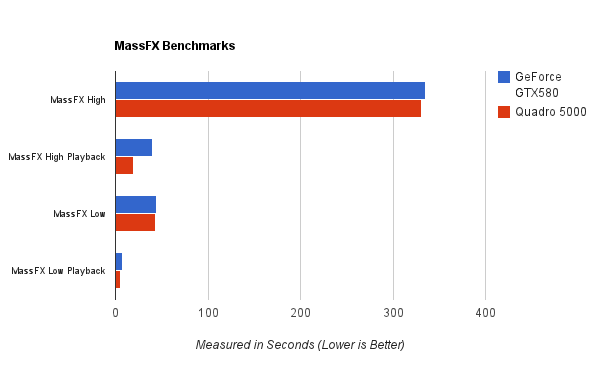
Nex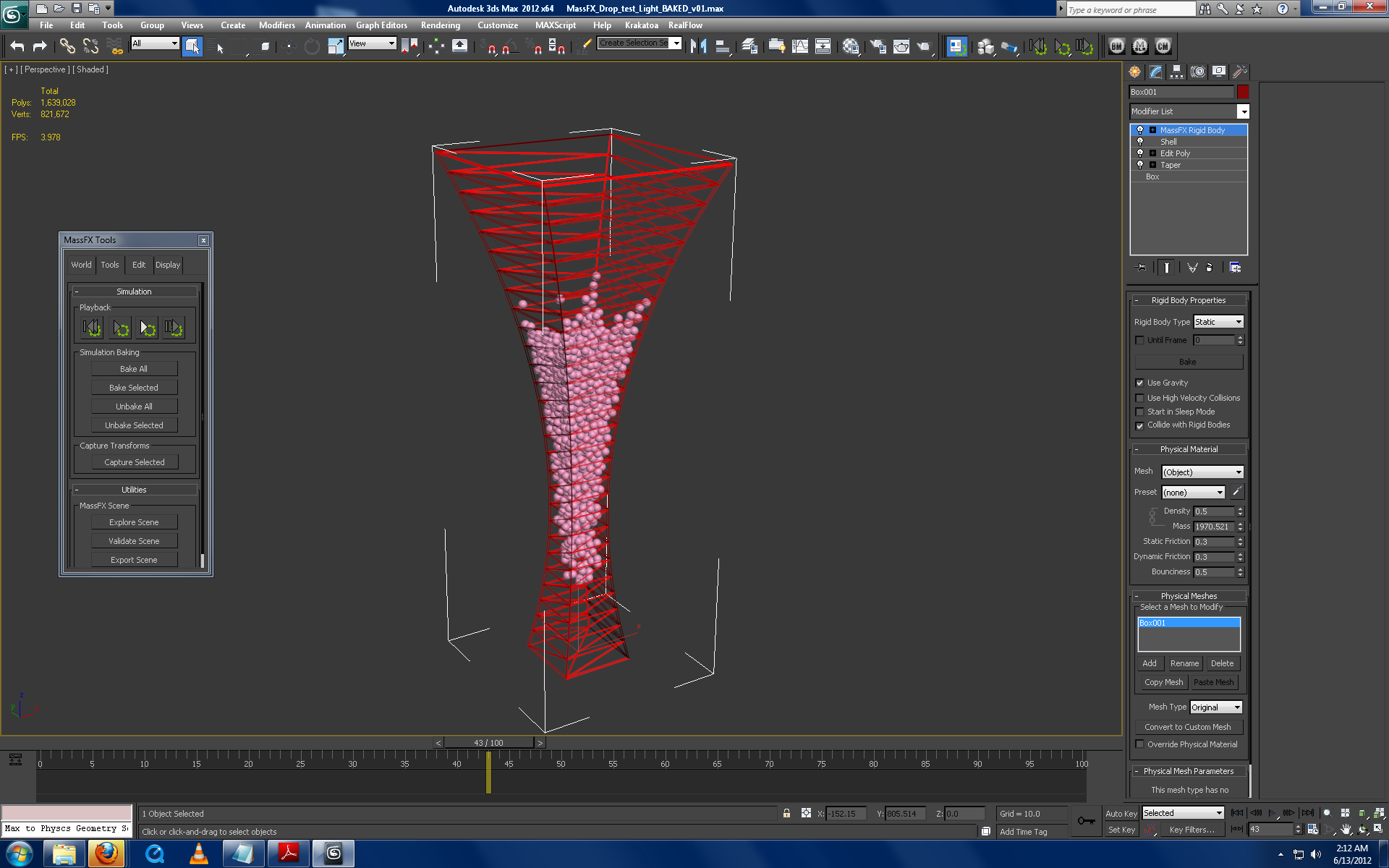 t we took the resulting simulations from test 5 and baked them to keys. We then timed the playback of that animation. The GeForce gave us an average frame rate of 3.3 fps with a playback time of 40.1 seconds, and the Quadro delivered nearly twice the performance with a 5.8 fps average in a total of 19.5 seconds.
Test 6 gave us the expected faster times for both cards, with the GeForce taking 44.5 seconds to calculate the 100 frame simulation and the Quadro narrowly besting its time with a 42.9 second result. Playback of the baked results from test 6 resulted in an average frame rate of 20 fps and 7.3 seconds for the GeForce and 24 fps and 4.9 seconds total for the Quadro.



How about new Titan… with 2600 CUDA cores… 6GB of memory… some said that’s 2.2x stronger then GTX 580. That would give us much stronger card still cheaper then even Q6000.
And how about quadro k5000?
I admit, I’m confused… 🙂
Yes thanks for the suggestion, We’re planning to do an update to this review with more up to date hardware. Stay Tuned.
i would love to see Titan versus K5000
3d max viewport performance
“NYC Max User Group | GeForce GTX 580 vs Quadro
5000” ended up being extremely compelling and
useful! Within todays society that’s really difficult
to execute. Thanks a lot, Jackie
[…] http://www.nyc3d.org […]
[…] http://www.nyc3d.org […]
Thank you very much for a great work!
Best comparison ever with clear conclusion.
So now I have to find some money for Quadro….
TITAN K5000 in 3DS MAX VIEWPORT, would be great!!!
What a great review!Thumbs Up!
Would be great to have an updated comparison between newer cards though..
Keep up the good work, this article was very helpful!